
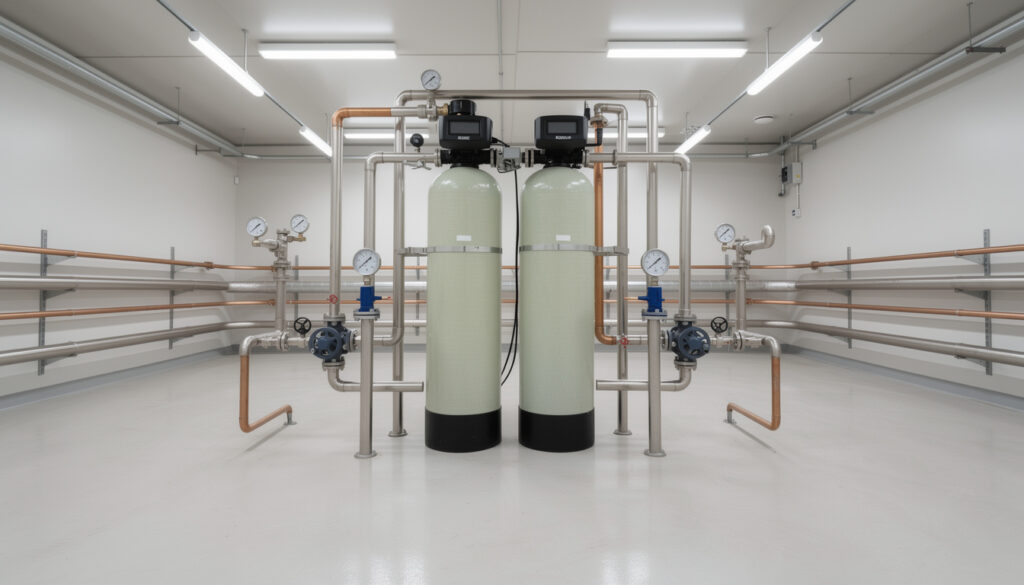
This guide explains How Commercial Water Softeners Reduce Scale and Operating Costs by exchanging the mineral ions that build insulating deposits. Replacing those ions preserves heat transfer efficiency and lowers lifecycle maintenance expense. Untreated dissolved minerals lead directly to premature equipment failure, higher fuel and electrical consumption, and excessive chemical use in boilers, dishwashers, laundries, and cooling circuits.
The scope covers the mechanics of ion exchange, the cost reductions in thermal and mechanical systems, the criteria for sizing and configuring equipment, and the diagnosis of common failures. Commercial water softeners are treated here as engineered process equipment, not household appliances.
The Mechanics of Ion Exchange and Scale Elimination
Hardness Chemistry and Calcium Carbonate Precipitation
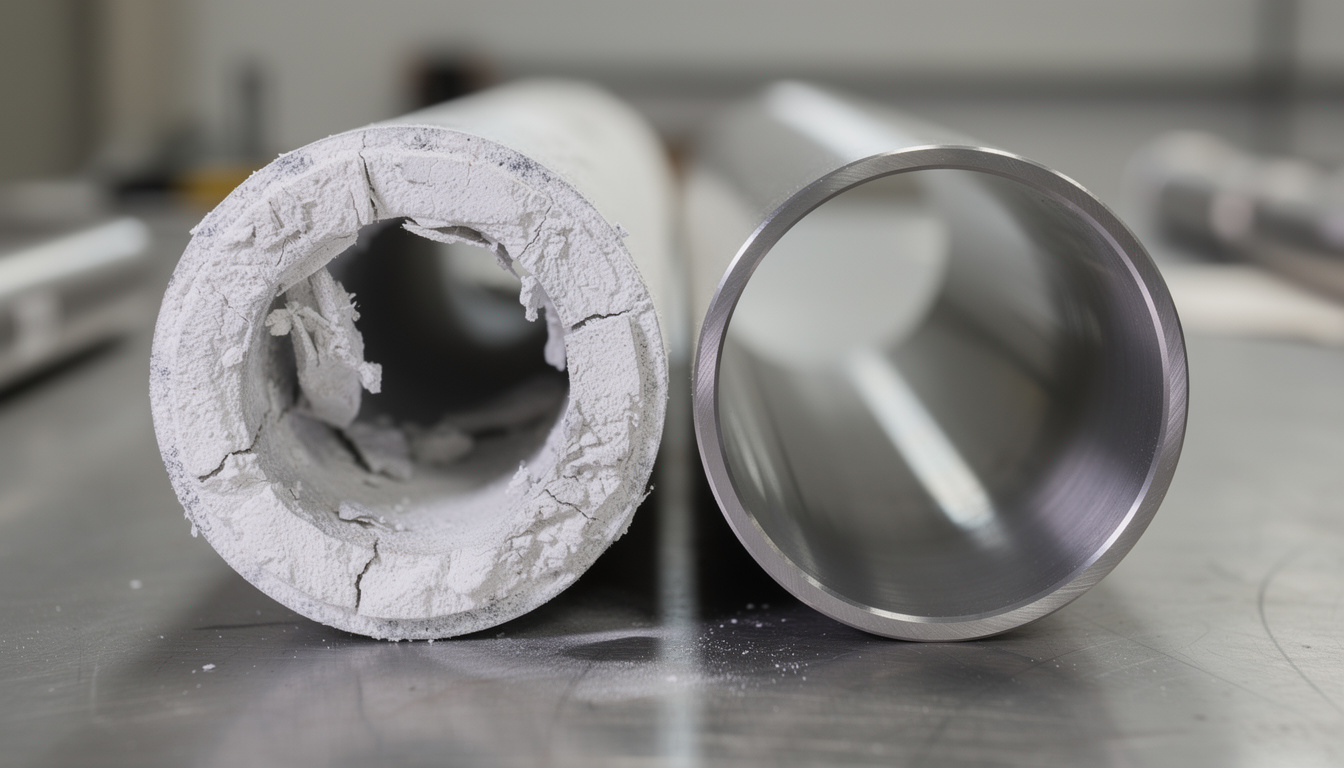
Hard water carries polyvalent metal cations, chiefly calcium and magnesium, reported as milligrams per liter (mg/L) as CaCO3. Heat and pressure changes in boilers, heat exchangers, and water heaters push soluble calcium bicarbonate out of solution as insoluble calcium carbonate scale. Magnesium hardness precipitates as its own compounds. The USGS hardness guidance lists the standard concentration classes for water hardness (CaCO3). Once formed, the deposit is a dense crystalline barrier on heat transfer surfaces, and its thermal conductivity is far below that of the metal beneath it.
The Sodium Cycle Softening Process
A sodium cycle softener contains polystyrene cation exchange resin beads cross-linked with divinylbenzene and loaded with sodium. As raw water passes through the bed, calcium and magnesium ions displace sodium on the resin in stoichiometric proportion, so the hardness mass is physically removed. This ion exchange softening differs from scale conditioners and threshold anti-scalants. Those products alter crystal shape or hold minerals in suspension for a limited time, and the hardness ions stay in the water.
What Does One Millimeter of Scale Cost?
A 1 mm layer of calcium carbonate scale can raise boiler energy consumption by up to 3% to 5%, because the deposit behaves as insulation. The DOE steam handbook documents how scale thickness reduces heat transfer and drives tube overheating. Scale prevents heat from reaching the water, so tube walls run beyond their metallurgical design limits, which produces blisters or sudden ruptures.
Savings also appear outside the boiler room. In dishwashers, laundries, cooling towers, and reverse osmosis (RO) systems, softer water lowers the consumption of detergent, descaling acid, and biocide. Acid-wash schedules become less frequent, labor hours drop, and unplanned downtime shrinks. Water heaters, steam generators, and process piping last longer when calcium carbonate scale never forms on their surfaces.
Sizing Metrics That Decide Whether a Softener Performs
Daily hardness load equals daily water volume multiplied by influent hardness. Equipment datasheets from North America often quote grains per gallon (gpg), where 1 gpg equals about 17.1 mg/L as CaCO3, so hardness load (grains/day) converts directly into metric terms. Continuous service flow rate in cubic meters per hour must be separated from instantaneous peak demand. An undersized unit produces excessive linear velocity, bed fluidization, and early hardness leakage, and the pressure drop across the bed at peak flow should stay below 1 bar to avoid starving downstream equipment.
| Parameter | Working Reference | Consequence if Ignored |
|---|---|---|
| Daily hardness load | Volume multiplied by influent hardness | Short runs and frequent regeneration |
| Service flow rate | Continuous m³/h plus peak demand | Fluidization and hardness leakage |
| Pressure drop | Below 1 bar at peak flow | Pressure starvation downstream |
| Iron | Below 0.3 mg/L | Permanent iron fouling of resin |
| Free chlorine | Below 0.5 mg/L | Resin swelling and bed compaction |
A full water analysis, covering pH, total dissolved solids, and temperature, precedes any specification. Iron precipitates inside resin pores, while chlorine and chloramines attack the polymer cross-linking.
Single-Tank vs Multi-Tank: Which Reliability Profile Fits?
A single-tank unit, on a timer or with meter-initiated regeneration, suits facilities with scheduled shutdowns, such as single-shift commercial kitchens or retail dry cleaners. During its regeneration cycle of 60 to 120 minutes, an internal bypass sends untreated hard water downstream unless an automatic shut-off valve is fitted.
Facilities that run around the clock need a continuous soft water supply. A duplex softener in alternating mode keeps one vessel in service while the other stands in reserve or regenerates. Duplex parallel and triplex layouts add staging controllers that bring extra vessels online as flow rises, which keeps velocity within rated limits. Redundancy also allows valve rebuilds and resin rebedding without stopping production.
Salt and Water Budgets: Where Regeneration Wastes Money
The brine tank produces a saturated sodium chloride solution for resin recharge. Salt dosage typically falls between 96 and 240 grams per liter of resin. Higher doses raise exchange capacity but sharply reduce salt efficiency, measured as hardness removed per kilogram of salt. Meter-initiated regeneration responds to actual water throughput, whereas a time-clock regenerates on schedule regardless of demand. Volumetric control can cut salt waste by up to 30%.
Backwash, brine draw, slow rinse, and fast rinse each consume water. The IAPMO monograph addresses minimum salt efficiency and maximum water use per unit of hardness removed. Optimized rinse durations and proportional brining reduce discharge, and local limits on saline wastewater entering sewers still apply.
Common Failure Modes and Where Softening Stops Short
Unexpected hardness leakage usually traces to one of four faults: a degraded bypass valve seal, a clogged venturi injector or brine line vacuum leak, channeling from a damaged underbed or excessive backwash rate, and resin fouling from iron or chlorine degradation of resin. Chemical titration or an online hardness monitor separates the causes. Leakage that rises late in a run indicates exhausted capacity, while constant leakage from the start of service points to a mechanical bypass.
Even a healthy sodium cycle softener has limits. Dissolved silica passes through cation resin and forms glass-like scale in high-temperature boilers. Swapping calcium for sodium leaves total ion concentration unchanged, so conductivity and corrosion risk in closed loops remain. Softeners therefore serve as pretreatment ahead of RO membranes, protecting polyamide layers from mineral scaling.
Frequently Asked Questions
Do commercial water softeners remove all dissolved minerals?
No. Only hardness ions are exchanged. Total dissolved solids, silica, and chlorides pass through, so other treatment stages are needed where those parameters matter.
What triggers regeneration in a metered system?
A flow meter tracks treated volume and starts regeneration when the calculated exchange capacity is nearly used. This avoids regenerating a partly loaded bed.
Can a softener alone protect RO membranes?
It removes the hardness that causes mineral scaling. Sediment, chlorine, and organic compounds still require separate filtration stages.
About the Business
AQUAPHOR Professional is a leading manufacturer of advanced commercial and industrial water purification systems. The company designs and builds water treatment solutions for industrial, commercial, agricultural, HoReCa, healthcare, and municipal applications. Its range includes high-efficiency ion exchange water softeners, commercial reverse osmosis installations, and customized filtration equipment engineered to prevent mineral scaling and reduce operating costs.